

The Streaming Wars and Affordability
The Streaming Wars and Affordability

Audio Recording by George Hahn
Netflix’s $83 billion deal to buy most of Warner Bros. would unite Stranger Things and KPop Demon Hunters with Game of Thrones and The White Lotus, creating a streaming powerhouse. With Netflix’s Ted Sarandos and Greg Peters at the helm, the combined company would also be led by the smartest team in the entertainment industry. I know Ted and, like most who meet him, admire him.
I don’t know David Ellison, and I find kids of billionaires trying to reshape the culture with a 12-figure jackhammer a bit … gross. But the Paramount boss — who’s trying to thwart Netflix with a hostile $108 billion bid for Warner Bros. — is right: A Netflix takeover would likely be bad news for consumers at a time when many are facing an affordability crunch. The fight over the century-old studio is also a great example of the cronyism and head-up-your-ass economics of the Trump administration that adds fuel to the crisis.
Anticompetitive
Ellison argued on CNBC that allowing two of the biggest streaming services to join forces is “anticompetitive.” As the son of Larry Ellison, the world’s third-richest person, Paramount’s CEO has close ties to Donald Trump and access to a seemingly bottomless pool of capital. It’s obnoxious listening to a guy raised in a gravity-free financial environment warning others about the dangers of market distortion. After giving that interview, did he go into the kitchen of the restaurant and lecture the line cooks on the dignity of minimum wage? I digress.
Socialism
After giving the elder Ellison a significant role in his plan to transfer TikTok’s U.S. operations to a group of American investors, Trump is pledging to get involved in the regulatory fate of a Warner Bros. takeover. This is straight-up socialism — the state controlling the means of production.
Everyone knows we’re sliding into a stew of autocracy/kleptocracy, so Sarandos also wooed Trump in the lead-up to announcing his agreement on Dec. 5, securing a secret White House meeting with the president. But before unveiling his rival offer two days later, Ellison reminded his adversary who has the political edge. The Silicon Valley scion was spotted beside Trump at a ceremony in D.C. Who the president, or podcasters, believe is the rightful owner shouldn’t matter. It’s simple: It should be whoever shows up with the biggest check and passes regulatory reviews.
Dominant Position
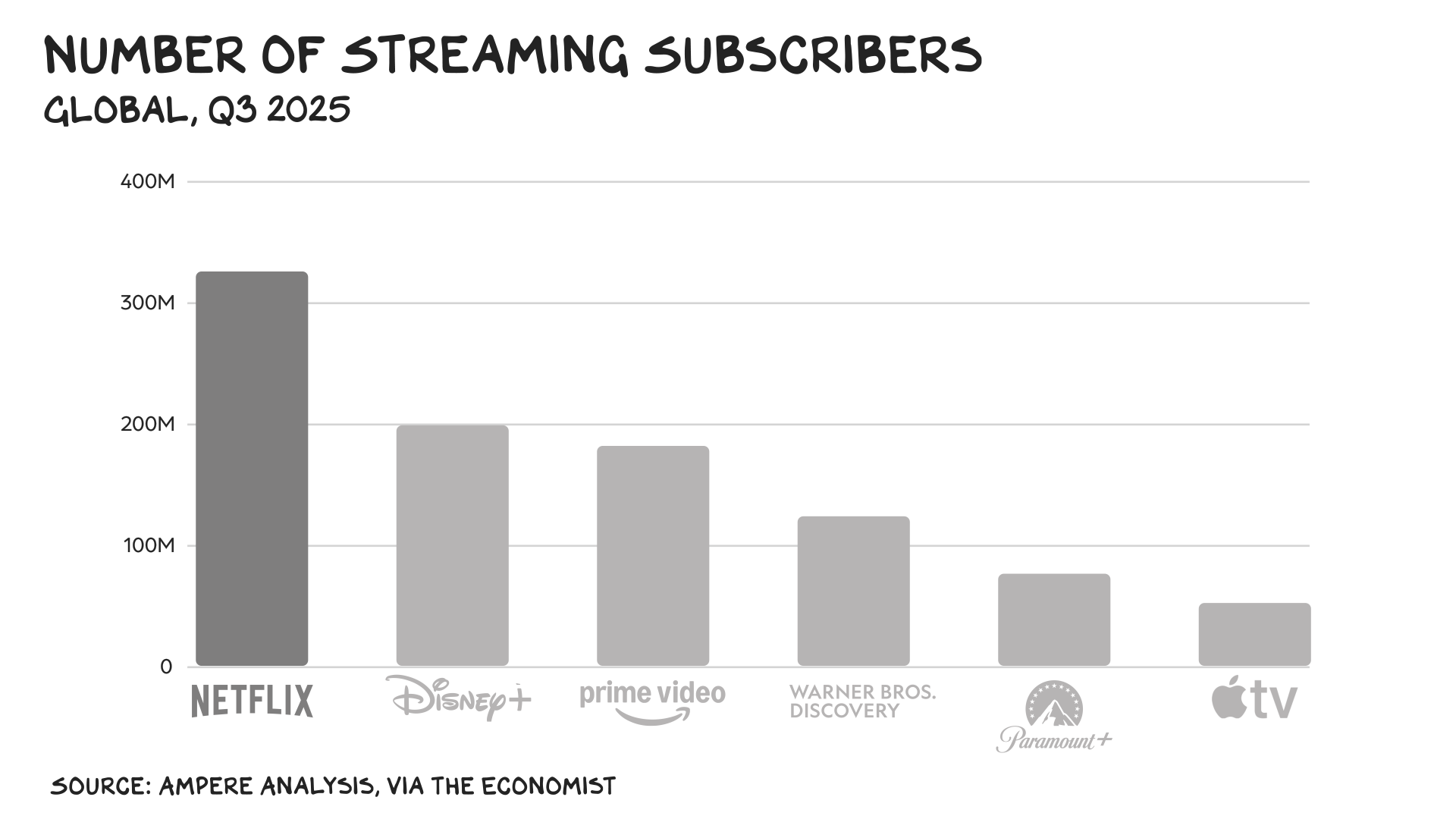
Concentration of power in streaming might corrupt the market, similar to the corruption the country endures when a few people can reshape media, tech and Washington. Anyway, back to streaming. With more than 300 million subscribers, Netflix already has a leading position. Netflix, Amazon Prime, and Disney control over 60% of the market. Acquiring Warner Bros. would give it even more power, with one of the largest libraries of premium scripted content and some of the most valuable entertainment franchises. Combining HBO — the gold standard of television — with Netflix — the streaming superstore — is like fusing LVMH and Walmart.
Less Choice, Higher Price
If Netflix captures HBO Max, the streaming war (ad-free, original content) is over. The upshot, despite Netflix’s assurances that the combo will create greater value for consumers, is fewer choices. At some point, as concentration intensifies, all the companies’ stocks will fall, as there are fewer people who can afford to buy their stuff.
This trend is well underway, with the top 10% already accounting for 50% of consumer spending, making the economy more fragile. One-tenth of the population can crash the train. A Paramount deal also raises competition concerns, given the two companies have rival film studios with theatrical releases and overlapping streaming services. But there’s a reason Paramount would probably face an easier regulatory path — and it’s not just the support it would receive from Trump. It boils down to market share.
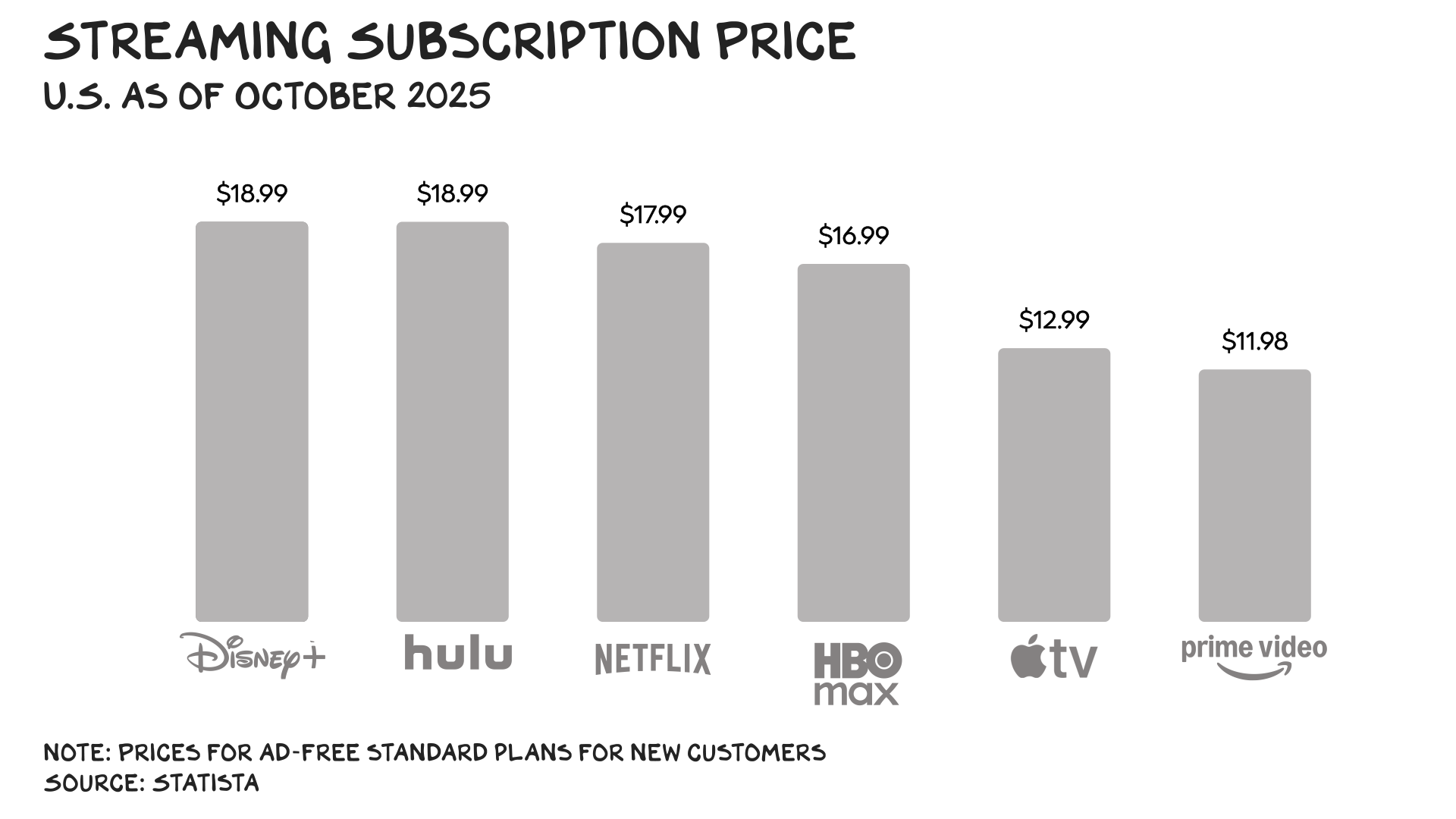
Streaming prices are climbing, along with the cost of groceries, gas, and housing, as the industry consolidates. The average subscription price for the top 10 U.S. platforms has risen 12% this year, far outpacing inflation, following double-digit increases since 2022. U.S. households spend an average of $70 a month on streaming services, a significant sum for people whose grocery bills have climbed 30% over the past five years.
Chicken vs. Beef
The companies say they have to raise prices to pay for the premium content they provide. But what the increases really signal is a transfer of capital from consumers and labor to shareholders. Adding the studio and streaming assets of Warner Bros. would give Netflix even more leverage.
If Netflix wins, the most critical question will be whether it’s competing with premium streaming platforms or virtually all digital video content vying for attention. Netflix isn’t nearly as dominant if you factor in Alphabet’s YouTube and ByteDance’s TikTok, as Kara Swisher, my Pivot co-host, points out. But regulators should adopt the narrower market definition. Otherwise it’s akin to chicken producers defending their control of the market by suggesting their competition extends to cattle ranchers and pistachio farmers.
Also, consolidation won’t stop with Netflix or Paramount and Warner Bros. The deal will only put more pressure on rivals, including Comcast, to follow with their own transactions to scale their streaming platforms.
From Indignation to Ideas
Streaming subscriptions are just one part of a wider debate. Everyone from Donald Trump to New York Mayor-elect Zohran Mamdani is talking about affordability. However, the country is long on indignation and short on ideas or programs to actually bring prices down. The president has insisted that tariffs will boost the economy, when in fact they’re pushing prices higher and fueling concerns over the cost of living. Trump, who once vowed to “make America affordable again,” now calls concerns about increasing prices a “hoax” perpetrated by the Democrats.
Americans know this is bullshit. The use of buy-now, pay-later services is rising to record levels this holiday season. Yet they’re also not buying the message from Democrats, who highlight the need to curb health, housing, food, and energy costs but resort to stoking outrage and throwing money at people vs. implementing concrete structural change. Here are four ideas that aren’t sexy (i.e., they will take work):
Build, Baby, Build
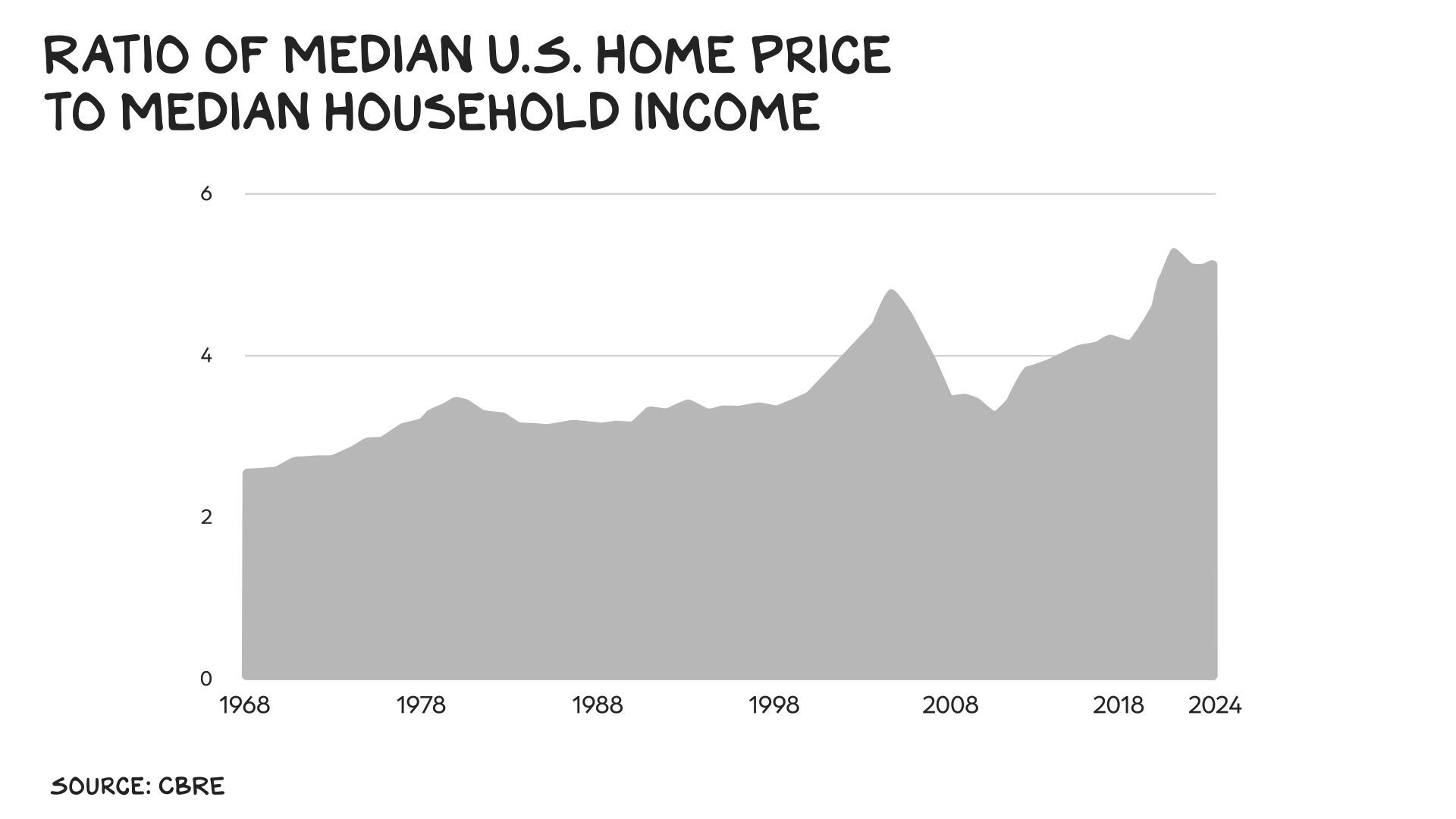
Housing should be at the top of the agenda, as it’s the primary culprit driving the lack of affordability. Half of renter households in the U.S. are cost-burdened, meaning they spend 30% or more of their income on shelter. Higher expenses curb labor mobility and productivity, deter families from seeking medical care, contribute to anxiety and depression, and fuel homelessness. While rent control is tempting, it suppresses development longer term, only adding to the problem. Higher costs for labor, building materials, and regulatory compliance exacerbate the housing shortfall.
We should have tax credits to unleash private development to build 8 million to 10 million homes in the next decade. Yimby laws (yes in my backyard) and cost-effective building are also part of the solution. Manufactured homes, built in factories and finished on site, are 35% to 73% cheaper than homes built entirely on location.
Nationalize Medicine
The U.S. healthcare system is broken — for the bottom 90%. Many Americans are one medical expense away from sliding into debt. More than 30 million citizens, especially Black and Hispanic adults, borrowed money to pay for healthcare last year, accumulating $74 billion in medical debt. Enough.
Let’s take Medicare and lower eligibility by two years every year for the next decade. That would bring the age of eligibility to 45 in 10 years. What is that called? Nationalized medicine. We can help younger people in other ways. They aren’t the ones accounting for the vast majority of surging health costs.
Impose Tuition Caps
We also need tuition caps based on income. As a freshman at UCLA, I benefited from an annual tuition of just $1,350 (and an admissions rate of 74%). A degree from a prestigious school opens doors and potentially quadruples the income a person can expect to make, but the ROI has declined as costs have ballooned.
If your family is middle-class, the tuition should reflect that. Colby last year announced a program to cap the cost of tuition, room, and board at $10,000 a year for families who earn up to $100,000, and $15,000 for those with incomes ranging from $100,000 to $150,000. That compares with a net price of as much as $53,000 a year.
If universities with endowments greater than $1 billion aren’t increasing freshman enrollment faster than the population is growing, they should lose their tax-free status. They’ve decided they’re Birkin bags, not public servants.
Trust-Busting
Concentration of power harms consumers and workers, with the benefits flowing to shareholders. It’s up to regulators to break up or block harmful oligopolies that stifle competition. The nation’s regulators are supposed to enforce antitrust law based on guidelines about market share and other standards, but giving the president the ability to “engage in post hoc manipulation” undermines the rule of law, as Herbert Hovenkamp, an antitrust scholar, told the New York Times.
More Oxygen
The pursuit of Warner Bros. is more than just a transaction. It’s a microcosm of a wider emergency. We can’t complain about surging costs while ignoring the factors behind them. We need to have an adult conversation, saying no to harmful deals and yes to policies that spur competition and rein in health, housing, and education costs.
It’s telling that the loudest objection to this nascent monopoly comes from a Hollywood mogul who’s never lived outside one. But we should listen to him. Consolidation is a tax on the young and the poor, levied to protect the old and the rich. Affordability begins with a simple idea: more firms, more competition, more oxygen.
Life is so rich,

P.S. This week I spoke with Tristan Harris, former Google design ethicist and co-founder of the Center for Humane Technology, about the AI dilemma. Listen here on Apple or Spotify, or watch on YouTube.
37 Comments

Scott Galloway
Professor of Marketing at NYU Stern School of Business and host of the Prof G and Pivot Podcasts. For Scott Galloway speaking inquiries, email speaking@profgmedia.com


Here’s Gemini suggestion to lower medical costs:
Systemic & Policy Solutions
Transition to Value-Based Care: Shifting from “fee-for-service” (where doctors are paid for every test or visit) to value-based payment models encourages providers to keep patients healthy rather than simply treating illnesses.
Increased Price Transparency: New federal proposals aim to make health care prices clear, allowing consumers and employers to shop for more affordable care and hold providers accountable.
Pharmaceutical Reform: Accelerating the approval of generic and biosimilar drugs and curbing patent-based strategies that delay lower-cost alternatives can significantly reduce drug spending.
Streaming Entertainment – Here’s my comment
CNN haven’t watched it in 30 years. I will not miss if it collapses. I have a backlog of 18tb of movies and tv shows that I have downloaded from the library and the internet. I purchased two 28tb drives in July on Amazon for $736. So setting up your own library is not cost prohibitive. Where I spent the big bucks is on a 115″ TV for $20k.
I respectively disagree with you on this Scott.
I’m not convinced that splitting content across more platforms necessarily improves affordability for consumers. A real-world counterexample is UK Premier League soccer broadcasting. When I lived in London, competition authorities forced the rights to be split up and then awarded to multiple broadcasters to prevent exclusivity on Sky Sports. In practice, fans who want to watch all of their team’s matches now -or even just have access to all televised games – have to subscribe to multiple services at a much higher total cost than when a single provider held the rights.
The issue is that TV and streaming content aren’t substitutable goods — a Netflix subscription doesn’t replace Disney+, and Sky Sports doesn’t replace TNT. Fragmentation can increase “choice” in a formal sense, but if consumers want specific content, they end up paying for everything rather than choosing the cheapest option. In that setting, more competition doesn’t automatically translate into lower prices or better consumer outcomes.
What I’m saying doesn’t by itself prove that consolidation (e.g., a big merger) can’t ever harm consumers through reduced choice or higher prices, but it does expose the need for more nuanced thinking about how competition functions in markets for exclusive content. We’re in an oligopoly world rather than a perfect competition one.
One of the most vexing things large streamers are doing is to charge for stuff that’s free on other channels. In the UK, there are free platforms like ITVX that are ad-supported and then you find on Disney+ that many of their programs you’re paying for are on there. Same with Netflix with C4 and the BBC when you can get many of the same films and programs for free. Paying £10/month for the chance to see one good film like Jay Kelly and The Roses and any old telly from the archives is increasingly unappealing. I know what my 2026 resolution is…
I’d go further than Scott in reining in the oligarchs that now run, in one way or another, the US and the rest of the Western world. However, his suggestions would be a good start. One of the main issues that needs to be dealt with is how to get talented young people to take up careers in politics instead of finance and tech.
I don’t have to buy there content stream.
‘there’ = their
Re: your point about the cost of college, I want to point out that the institution I work for (University of Illinois Chicago) makes tuition free, yes $0!, for any first time enrolled undergrad whose combined family income is less than $75K! Go to free.uic.edu
I’m so proud to be working for an institution/system that is as diverse and committed to social mobility, and really walks the talk.
Part 3.
6. Capitalism has lifted more people out of poverty than any other socioeconomic system. Yes, it can be brutal- because it drives efficiency by rewarding capital that is properly deployed while destroying capital that isn’t. It creates jobs and eliminates them based on demand. Misallocated resources (labor or capital) only makes everyone poorer.
“The world is about 100 times wealthier than 200 years ago and, contrary to popular belief, its wealth is more evenly distributed.” “Everyone is not better off. If they were it wouldn’t be progress, it would be a miracle” S Pinker
Part 2:
4. You’re right… Inflation is a problem. What causes inflation? Excessive Government spending. Nothing steals from the working class more than inflation. It’s insidious because it’s invisible theft. The upper class owns assets, largely shielding them from the theft of inflation- as the assets increase in value.
5. Big government is the worst monopoly- Corruption, inefficiency and waste are hallmarks of Government- the largest & worst monopoly with no competition and no market mechanism to measure success or failure. And it grows using threats of coercion and violence to enforce its will reducing liberty with ever expanding rules and regulations. Our founding fathers new that we needed government to have a civil society and also new of the accompanying dangers- which is why they wanted a LIMITED government.
5. Over regulation raises costs and actually harms the people they were intended to help. The quickest way to increase the housing supply is to reduce housing regulations encouraging investment- people don’t risk their capital to lose money.
So many things wrong here. Where to start? LOL
1. We don’t need more competition. Economies of scale is efficient and creates more aggregate value. Must you be reminded that Walmart put smaller entities out of business by delivering lower prices and more value to the consumer actually raising their living standards?
2. Streaming has created an abundance of entertainment- cheaper than ever before. This is progress. To get there companies frequently lose money before they reach critical mass. Capitalism enables this- upfront losses leading to windfall gains by delivering more value to the end consumer. Rinse and repeat.
3. Scott- It’s called capitalism, not laborism. Take the risk and succeed- and your capital is rewarded. It drives efficiency and progress. Labor is valued based on supply and demand. This is efficient as it properly allocates resources. Too many truck drivers and their pay declines. Not enough, and their pay increases. Don’t like it, pursue a different career. Want even more, risk your own capital and start a business.
Jeff’s a typically dim arrogant ideologue.
I understand- some people are better off living off the back of others. Merit doesn’t suit those at the bottom. Eventually you run out of OPM (other people’s money). Have a blessed day.
Scott, I’m usually a fan, but you whiffed on this one. We’re talking about streaming media and media in general. Affordability doesn’t belong in this discussion. No one needs streaming media. No one needs Warner Brothers or Netflix. Those are benefits available to people with comfortable enough incomes.
People need housing. They need food. They need transportation. They need health care. They do NOT need Game of Thrones or ESPN, or any other set of channels. If they want to pay for those things, great, that’s their privilege and their money. If those services turn out to be overpriced, they’ll lose customers just like anyone else.
Save the angst and drama for stuff that matters.
It’s like you only read a fraction of the article.
I canceled Netflix years ago. I don’t own a TV. Even I did I would never watch Warner or Paramount or 99% of all the other streaming steaming crap. Who cares if someone has a monopolistic advantage. Its mostly useless crap anyway that no consumer has any compulsion to waste their money on.
It must be nice, Henry, to be the only person in the world.
Every person is the only person in the world, in that they have complete ownership and agency of themselves. No one is coerced to consume streaming or other content, nor generally is it essential to one’s well being. It’s mostly useless distraction.
Can we take bets on if the Clintons are going to show up for the depositions next week?
Bill Clinton’s deposition is scheduled for December 17, 2025.
Hillary Clinton’s deposition is scheduled for December 18, 2025.
I got a feeling (Not a statement of fact, just a feeling) that those depositions are not going to happen.
It’s this amazing super power the Clintons have to just ignore subpoenas and nothing happens.
The world doesn’t work the way we think it does.
> Delete the Weakness in your life
Like being off topic and stupid?
“But what the increases really signal is a transfer of capital from consumers and labor to shareholders.”
No, that’s what we call commerce. What is missing in the argument is the consumer. The bloody consumer doesn’t have to buy any of these offerings. Go read a book.
The rest of your unrelated column is just garden variety socialism. Nothing new or creative there. Just socialism.
The answer to much of the housing affordability issue is not more single family housing; it is more multi-family housing.
There is no land, as an example, in Manhattan.
Build a commuter rail that works and develop a city of 500,000 — and edge city connected to Manhattan with superb rail and buses. That is how housing becomes affordable.
Cheers and Merry Christmas. God bless us all.
This. TY!
> Go read a book.
If only you would, you clueless git.
If Netflix and WB (owners of Max) combined their services, they could end up with one service that’s no more outrageously priced than either service is now, taking a superfluous service (Max) out of a crowded field.
I can’t imagine that Comcast or Paramount would want WB if there’s a chance they could get stuck with CNN, since any administration could strike at broadcast licenses to pressure CNN, as the Biden administration put feelers out about doing to Fox over its news channel. I hope that prospect has discouraged their honchos from pursuing a merger.
I saw that they might try to spin it off anyway, but I don’t think President Trump can do anything to Netflix, since it has no broadcast stations.
Housing is too expensive.
Automobiles are too expensive.
Education is too expensive.
Healthcare is expensive.
A Dollar buys about half as much as it did a few years ago.
Manufacturing and Manufacturing jobs has/have moved overseas.
Netflix shouldn’t be allowed to buy WB.
Pretty much agree but what are the real solutions? Can you stop WB from selling, stockholders only care about profit taking. Health care issue is something else and what needs to be addressed is reducing the actual cost of healthcare, liability insurance or guarantying insurance companies a fixed profit? and I do accept everyone being under Medicare, i.e socialized medicine. One thing to consider may be if the government plays any role in supporting the development of a drug, that drug price then becomes dictated by the government.
The greatest danger in this war if Paramount wins is its changing CNN to. right -wing service. That will really kill the chances of U S. democracy surviving. Netflix should up its offer to include CNN
Lots of great ideas…yet one problem. Someone has to pay for all these subsidies your asking for…we call this Socialism and goodness we need to reduce our debt, not add more. Shocking how socialist ideas make it to print so often.
Shocking how many idiots blather about sOcIaLiSm.
Can you point me to the word ‘subsidy’ in the article? I thought Scott was calling for freeing up the market in housing education and health care.
More affordable housing is probably most needed in urban areas. I’m thinking specifically New York City as I lived there for 12 years. But the question is – where do you build those homes? There’s no land in Manhattan where everyone wants to live. And the other boros aren’t much better. And while there may be land in the LA area, it’s likely unaffordable for lower cost housing. And I’ve lived there, too. So while I agree with the need, I can’t see a way to make it happen
I liked today’s entry. And most of your politics, though I am a democratic socialist. A friend’s Stalinist grandmother, author Meridal LeSeur, used to curse about FDR, saying we could’ve had communism, but Roosevelt saved capitalism with his liberal programs. I used to laugh at her. She dug the misery of the American public, which I knew to be pathetic. Your brand of liberalism could preserve capitalism, introducing some badly needed humanity. Kudos.
Would you please consider running for president??? PLEASE!!!
Scott, specifically to the streaming wars/acquisition/consumer pricing. It isn’t a case of competition keeping prices down for consumers. I already pay for both Netflix and HBO (and Paramount too). If you rolled Netflix and HBO together and raise Netflix’s price 20-25%, I’d still pay less than I am today for both streamers. Is there a problem of influence and control with Netflix and HBO together – yes, but for the industry, not the consumer. But as Kara has said, Hollywood has had its head up the you-know-where about the economics. Maybe a better play is to let studios get back into owning theaters (distribution) since Netflix owns the distribution for the IP it has.
I agree completely
This is spot on. It’s about the builder of the trains owning the tracks. Netflix should be broken up into distribution and production, and this merger would be just fine. And agree with another poster that the true danger, larger than the weak sauce of affordability, is that one party owns all the major media and news outlets. Goodbye, Democracy. This merger is all about that, and that is why Trump will allow it as long as CNN goes over to the fascists.
Hi Scott, I agree with this article pretty much all the way through, however my concern is what happens to CNN if another FOT (Friend of Trump) controls it – especially since Trump has already signaled that he would significantly alter its broadcasting if he could.
Appreciate the four ideas to improve our country. It would be great to have politicians interested in solving problems vs blaming each other and protecting special interests.