
The Cult of Therapy
The Cult of Therapy

Audio Recording by George Hahn
“Don’t read the comments,” I tell people, just before I have a drink and … read the comments. I knew my book Notes on Being a Man would spark controversy, as you get the most flak when you’re over the target, and some of the criticism (likely) misses the mark. The comment that hits home: I reverse-engineer what’s worked for me (economic security, relationships) to masculinity and don’t acknowledge other paths to fulfillment. Fair. Many others offered constructive criticism, and some of the criticism has merit. What surprised me was how many of the commenters were therapists parroting talking points along the lines of “Before anything, men must work on themselves (i.e., get therapy).” This is nonsense.
Luxury
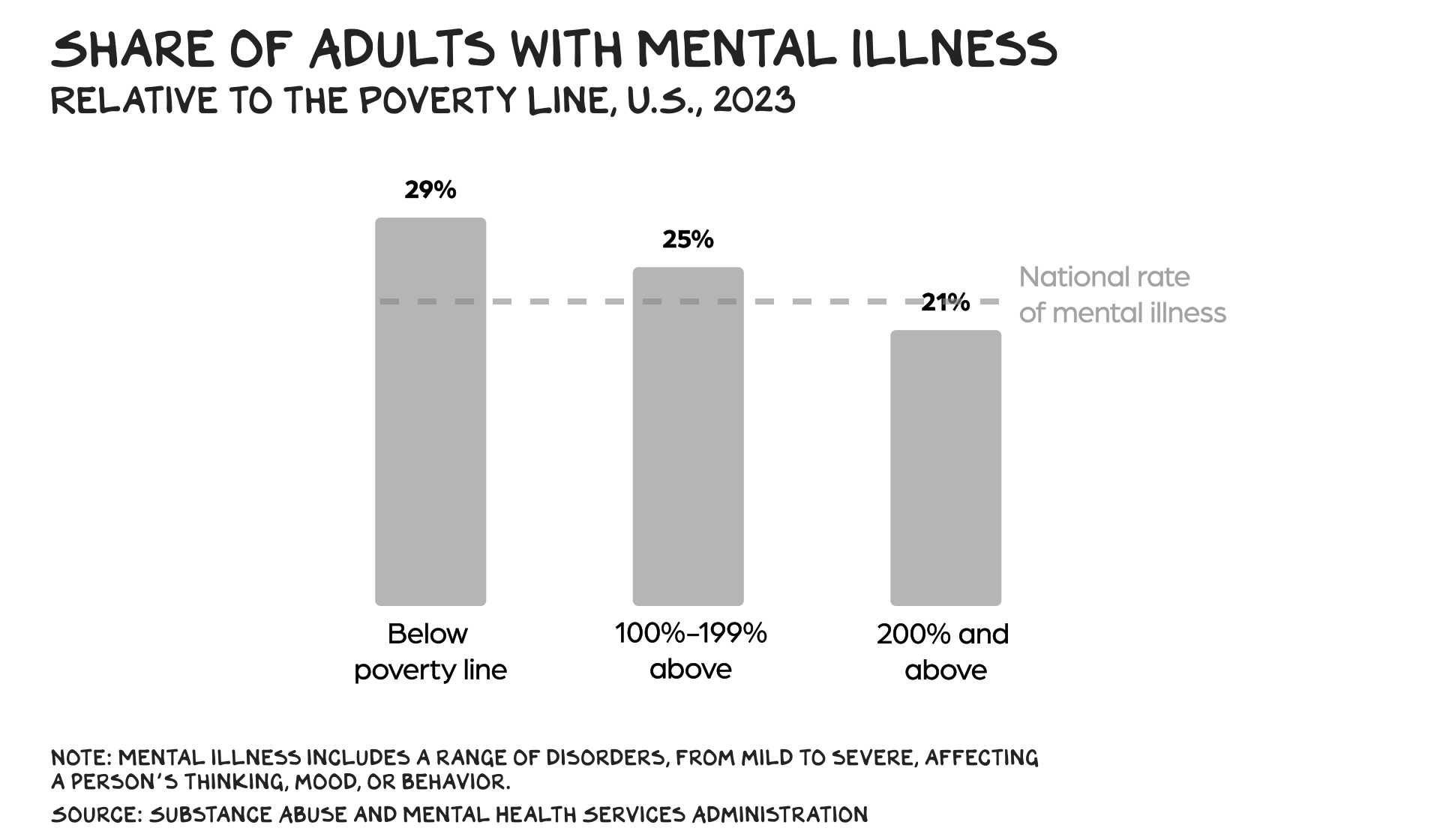
I want to be clear: Therapy is a good thing, especially for the 23% of American adults who experience mental illness. But mental health influencers position therapy as a prerequisite for a better life, rendering it a Birkin bag for your feelings (i.e., a luxury good), and position many of life’s obstacles as traumas to be addressed for $200/hour. This is a misdirect. I believe America’s mental health crisis is a multidimensional problem largely shaped by economic precarity. Five of the world’s 10 happiest countries are Nordic nations with strong social safety nets. Costa Rica and Mexico (ranked 6th and 10th) achieve comparable happiness scores thanks to their strong family and social ties. My solve? A: Detonate a mental health bomb in America, and invest in programs that increase material well-being — a $25/hour minimum wage, affordable housing, universal healthcare, and a stronger social safety net. The free gift with purchase? Reducing financial stress would mean Americans could worry less, socialize more, start families, and, if they struggle with mental health, pay for therapy.
Therapy Culture
Doctors currently believe there are 227 symptom combinations that can lead to a diagnosis of depression, but there are no blood tests or imaging scans to aid that diagnosis. In an estimated 15% of cases, antidepressants provide benefits beyond the placebo. Talk therapy also helps, but the range of modalities make it difficult to quantify the impact of treatments. As neuroscientist Barbara K. Lipska wrote in 2018, “mental illness remains deeply enigmatic, its causes generally unknown, its cures undiscovered.” And yet, social media feeds are overrun with mental health influencers peddling therapy as the answer.
Writing in the New Yorker, Katy Waldman observed in 2021 that therapy-speak had left the couch and conquered social media. It’s only gotten worse: Scroll through your feed and you’ll see posts about self-care, coping mechanisms, codependent relationships, and avoidant attachment styles. Centering ourselves, setting boundaries, sitting with our discomfort, and being present don’t require explanation — these terms are as essential to internet culture as LOL. For many this vocabulary screams privilege. According to Waldman, the confessional/performative nature of social media results in “the language of suffering often find[ing] its way into the mouths of those who suffer least.”
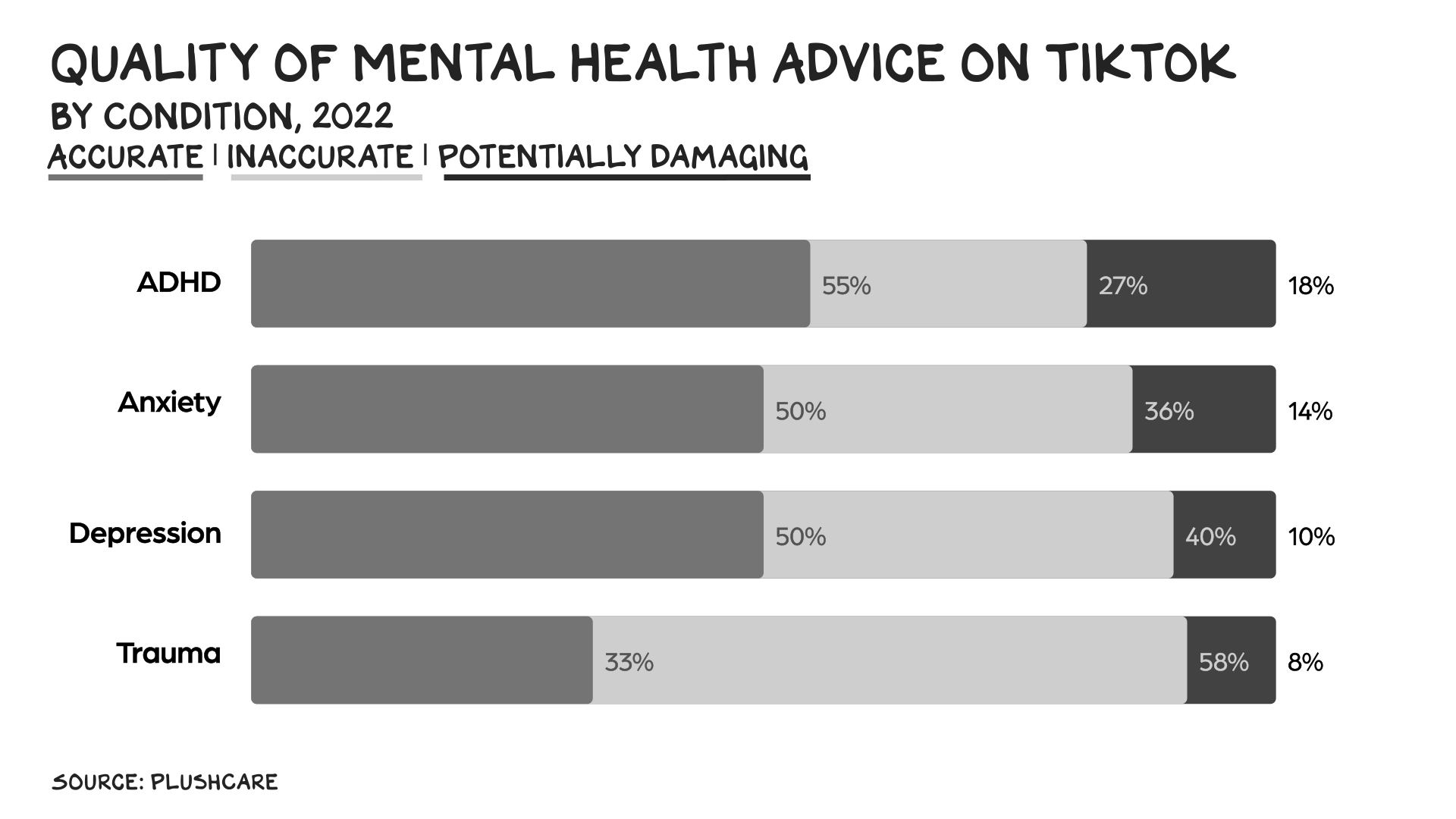
Scaled beyond its intended domain, therapy-speak is corrosive. According to psychotherapist Jonathan Alpert, the rise of therapy culture has turned a tool for meaningful change into a “comfort industry” that’s making Americans sicker, weaker, and more divided. “We live in an era where disagreement is treated like trauma, and emotional reactions are weaponized for political gain,” Alpert writes. “On social media, vulnerability is currency. On TikTok, influencer ‘therapists’ dish out instant validation in 30-second bursts. The most anxious voices often hold the most influence. Complex issues get reduced into content. Millions watch, but few get better.” One 2022 study of mental health videos on TikTok found that 83% were misleading, 14% provided potentially damaging advice, and only 9% were produced by content creators with relevant professional qualifications. Similar to supplements, therapy is a good thing that’s easily exploited by hucksters. But if supplements are a pipeline to getting red-pilled, therapy culture is a sinkhole of misinformation, manufactured fragility, and needless suffering.
You Need to See a Therapist
I’ve had limited experience with therapy. Before my divorce, my wife and I saw a couple’s counselor. I’ve also tried ketamine therapy. The session was illuminating, but I haven’t gone back. There was a time when a couple in a bad marriage would’ve talked to a priest. But the share of adults who say religion is an important part of their daily life has dropped from 66% in 2015 to 49% today, according to Gallup, closing off one avenue of talk therapy for many Americans. Sharing your troubles with your local bartender has also fallen out of fashion. Talking to your friends remains an option, though friendship rates are declining, with 12% of people today saying they have no close friends at all. Alcohol consumption is at a 90-year low, with Gen Z driving the abstinence trend, robbing young people of one vital form of social lubrication.
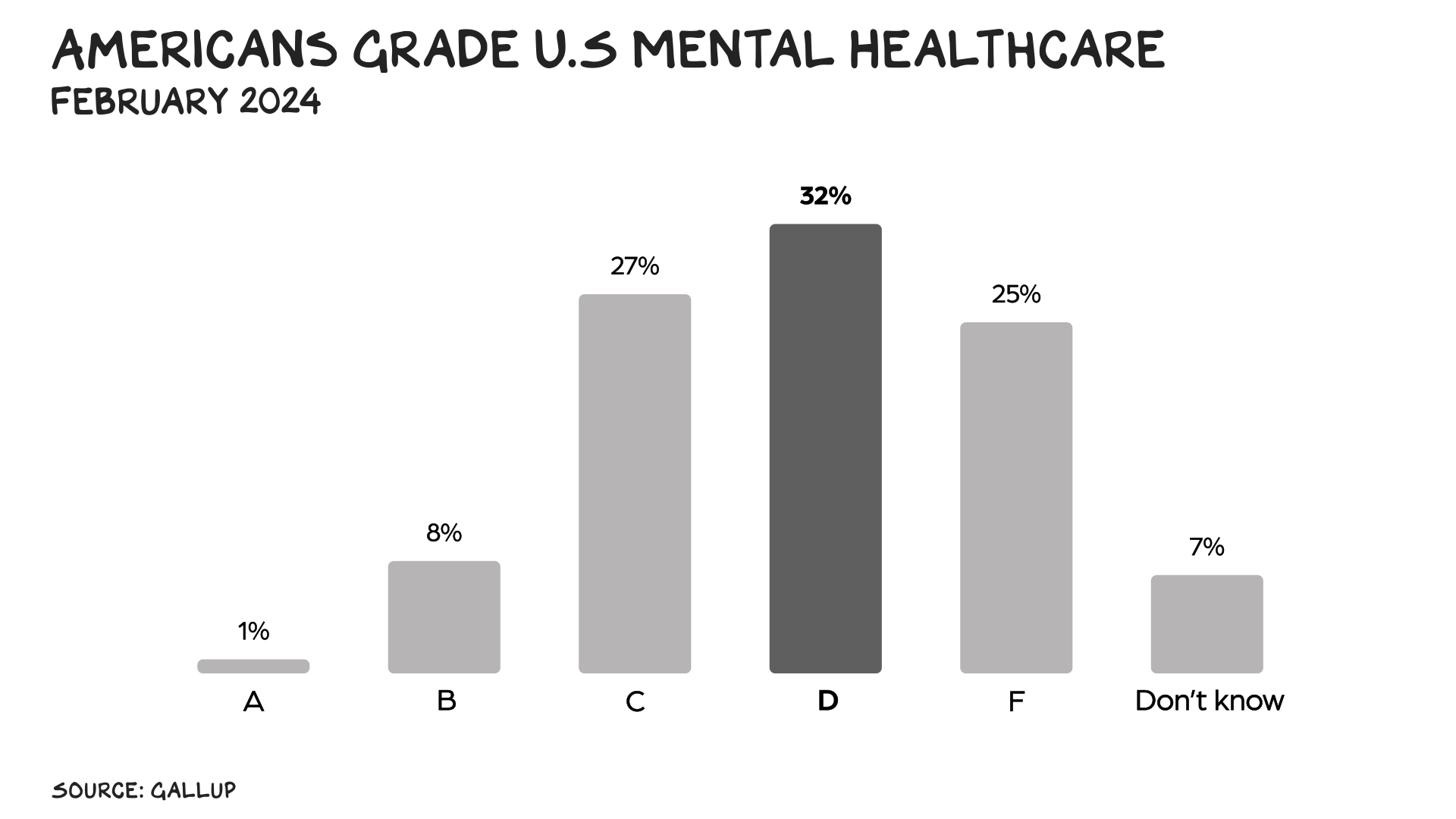
I’ve been criticized for saying alcohol can be additive for many young people, but the risk to a 25-year-old liver is dwarfed by the risk of social isolation. If I told young people to attend church, I’d likely get pushback from some quarters. Meanwhile, counseling young people to invest in their fitness and take social risks so they can make friends and form romantic partnerships are nonstarters for therapy culture … unless and until you’ve had therapy. We’re social animals. As social connections atrophy and fray, we’re becoming more anxious and depressed. Therapy is an expensive Band-Aid for a larger problem. But even taken on its own merits, only 9% of Americans give the U.S. healthcare system a grade of A or B for addressing mental illness, according to Gallup.
Money Talks (Therapy)
The U.S. has a shortage of mental healthcare providers. But where some see a supply problem, I see a distribution problem. Including psychiatrists, psychologists, licensed clinical social workers, counselors, marriage and family therapists, and advanced practice nurses specializing in mental health care, there are 344 mental health practitioners per 100,000 people in the U.S. We have more mental health practitioners than medical doctors (297 per 100,000) and 5x the number of dentists. According to the U.S. Bureau of Labor Statistics, employment for some mental-health-related occupations is projected to grow by 18% over the next decade — faster than the 3% average for all occupations.
Cost is the No. 1 barrier to accessing mental health services, according to the Kaiser Family Foundation, while getting time off work ranks second. Stigma comes in fourth, behind concerns about efficacy. The two-thirds of Americans who have private insurance likely have access to mental health services, though one-third of therapists don’t accept insurance at all. If you can swing $280 to $400 a month, platforms like BetterHelp are an option. (Note: BetterHelp is a Prof G podcast sponsor.) Meanwhile, Americans living in rural areas likely can’t find a therapist at all. According to one study, counties outside of metropolitan areas had one-third the supply of psychiatrists and half the supply of psychologists as their more urban counterparts. People covered by Medicaid and Medicare struggle to find providers that accept their insurance because of the low reimbursement rates. Finally, underserved groups — people of color, non-English speakers, and LGBTQ communities — often struggle to find appropriate services. But if you’re wealthy, therapy is as easy as reserving a space at SoulCycle. According to the Wall Street Journal, the next big thing in luxury travel is a vacation with a family therapist. The price tag: $80,000.
For everyone else, AI therapy is Sam Altman’s answer. Therapy/companionship was the No. 1 AI use case in 2025, up from No. 2 the previous year. One trial for an AI called Therabot found that it achieved an average 51% reduction in symptoms of depression and a 31% decline in symptoms of anxiety, compared with people who got no treatment. But Celeste Kidd, a psychologist at the University of California at Berkeley who tested another therapy AI called Ash, concluded it was “clumsy” and unresponsive. I’m bullish on AI, but even if it eventually outperforms human therapists, I’m skeptical that Big Tech will provide adequate guardrails. See: Kara Swisher’s interview with the parents of Adam Raine, who died by suicide at 16. They’re suing OpenAI, alleging that ChapGPT was complicit in their son’s death.
Missing Man
No group in America has fallen further, faster than young men. When I began talking about this several years ago, that was a controversial statement, especially on the left, where many pathologize masculinity. While the right has suggested the solution is to take women and non-white people back to the 1950s, the left’s view is that young men don’t have problems, they are the problem. Neither attitude helps. As the left ignores the issue, the right fills the void with misogyny and racism. The result is that a significant number of young men, embracing figures like Andrew Tate and Nick Fuentes, swung right, helping elect a strong man. (If strong equals corrupt and stupid.) To borrow from the vocabulary of therapy-speak, young men don’t feel seen/heard in spaces that are the polar opposite of the manosphere.
Women are twice as likely to receive mental health treatment as men. But is that a failing of masculinity, or the mental health profession, where three-quarters of providers are women? “Guys are built differently,” clinical psychologist John Farrell told Monitor on Psychology. “They have different brains and different ways of being emotional. Male therapists understand male issues differently than females do.” If that sounds sexist, change the pronouns and get back to me.
Therapy has a lot to offer. It also has massive blind spots, especially around class and gender. It’s easy to sling bromides about how everyone needs therapy, but it’s more productive to ask why therapy excludes so many people and too often fails to help the people it does reach. If you’re looking for help on social media, understand this: The platforms and influencers make more money when you stay broken.
Life is so rich,

P.S. This week I spoke with Pulitzer Prize–winning historian Anne Applebaum about what’s really happening inside the Ukraine peace talks. Listen here on Apple or Spotify or watch on YouTube.
81 Comments

Scott Galloway
Professor of Marketing at NYU Stern School of Business and host of the Prof G and Pivot Podcasts. For Scott Galloway speaking inquiries, email speaking@profgmedia.com


From a 79 year old therapist from the 60’s , You are ” right on”‘ Scott—-
I love this. I just found Scott through the 10% happier podcast and it was illuminating for me. I have an adult son who is struggling. His comments really helped me see his issues more clearly.
On this article, I agree the way people self diagnose through the internet is crazy. They toss out terms like bi-polar and ADHD like they are a badge of honor. Or worse, an excuse for bad behavior. We live in a drug culture where we think everything can be fixed in a minute. Myself included. Once you get a diagnosis, you see a psychiatrist once every 3 to 6 months for your meds. Not much discussion about changing behavior.
It takes some time to find a therapist that can guide you, that is right for you and many people don’t have the resources- time or money – “do the work”
I have to give a shout out to my employer who offer 18 free therapy sessions a year. 6 of these can be used for coaching and/or healthy lifestyle help.
the author is correct about the dearth of etiological knowledge. We have zero agreement on any (that means NOT ONE) diagnosis etiology. I don’t think any author is qualified to say who is suffering the most or the least. I do agree that a healthy society would make it easier for people to live and thrive. Interesting piece
context is important – ie history. but broadly good health system, safety and financial safety net are key
gokulram arunasalam
Scott – I know this may sound like hyperbole, but I have developed a radical concept that has the potential to completely change the way our financial systems work and turn the tables of data monetization around in favor of the consumer. I reach out to you as I think your insights would prove invaluable. Really hoping you read this and happy to connect with someone from your team for screening. Thanks in advance.
So in the lingo of the kids… if people have more financial security they can self care better, and avoid crises, thus reducing the need for professionals?
That is a rich take. It honestly highlights why therapy is so essential. As a white privileged male with economic security, I know how easy it is to lack empathy. Actively going to therapy is what allows me to further develop those missing skills and become a more well-rounded human. It might do the same for you.
You really need to visit a Chabad House.
Again, I hope someone will help me stop an unethical hypnotherapist, since no one would want to hypnotherapized without their knowledge or consent. In a just society, that means no one wants anyone to hypnotherapize me without their knowledge or consent.
When I didn’t know it was going on, I faced a lot of bullying. I know those bullies were told by a corrupt authority figure that it was okay to do that, but that’s what Hitler’s followers could say for themselves, so I don’t feel very warm toward anyone who would bully me for a corrupt hypnotherapist.
That includes anyone associated with Psychology Today, once I asked a contributor known to those who know his true character as John Sleazy Ryder in his comments how you stop an unethical hypnotherapist.
Sleazy, unethical asshole that he is, chose to mock me instead. Through his assholery, I understood that he’s a buddy of the unethical hypnotherapist.
If TP editor Kaja Perina were an ethical human being, she would have made damn sure that the unethical hypnotherapist stopped abusing its power on me — stopping the unethical hypnotherapy.
Once I know Kaja obviously has no regard for ethics or the morally right thing to do, I can’t see how TP contributors, almost all psychologists, could fail to understand that she’s what they would describe as a narcissistic psychopath.
If they’re writing for TP, they’d have to be either incompetent or completely unethical.
That makes all of TP toxic waste.
I will thank Sam Goldstein, though, since he said I can be rude to corrupt authority figures. Since everyone at TP is definitely a corrupt authority figure until they’ve stopped the unethical hypnotherapist as I’ve requested, he and Kaja have approved any possible rudeness in my post.
If it’s okay with Sam Goldstein, Scott shouldn’t have any problem with it.
In fact, I hope Scott will join me in my call for a hypnotherapy ban. There already are such bans in Belgium and Israel; I’d hope Americans can be as forward-thinking.
What bothers me most about the criticism of you and your arguments for the need to address a crisis among young men is the constant chorus of “Yes, but what about, women, minorities, and other historically neglected people.” In her November 9 New Yorker article, Jessica Winter attempts to invalidate your point and proceeds then to criticize a “centrist manosphere” whom she acknowledges as being centrist, but nevertheless guilty of being dismissive of the needs of others. “So why make this about manhood?” she says. Clearly you acknowledge time and again in your book that of course, men are not the only neglected group. But your point IS about men. However, Winter, like so many others, insists on vilifying your argument, attempting to diminish it because the needs of others are also unfulfilled. What is it about so-called progressive thinking that screams you cannot acknowledge one group without advocating for all simultaneously? It is this type of thinking that has produced the culture where every child gets a trophy, kindergarten graduation ceremonies, and all the other empty acknowledgements for non achievement that serve to stifle true accomplishment and foster inertia. I have taught both boys and girls for 40 years. It serves neither to insist on “me first” in the guise of “me too.”
EVERY intervention of any kind to impact on any phenomenon known to man does not work all of the time, and most do not work at least half the time…look at medications, physical therapies, diet regimens, athletic performance improvement, rocket launches, designs of a car, designing an investment system….So. When it comes to the question of why psychotherapy/talk therapy does not work…well it just raises the age old issue…why does human intervention fail so often ? Why do human beings fail so often. Why to empires and cultures and religions fail to achieve the goals of any type. Yes, therapies fail…because of the human condition,,,the DIVINITY’s great joke.
It just feels like you’re conflating different things here to support your own conclusion.
TikTok is not therapy. And you’re right to call out the damaging effects of harmful advice on social media.
But when you conflate that with actual therapy, you’re causing harm and adding to the stigma of actually seeing a therapist.
Furthermore, the economic barrier of seeing a therapist is real, but that’s a different conversation, and instead of suggesting men “drink more” instead of therapy, we should be advocating for better accesses to heath care.
I wish you would see this is a nuanced conversation and acknowledge it, rather than spreading damaging advice of your own.
This was horribly reductionist and really makes you sound like a contrarian bro.
How brave to take aim at people devoting their lives to healing others. Yeah, get em you brave warrior for justice! Nevermind the systematic corruption of the EPA or catastrophic economic situation many are starting to find themselves in.
Let alone the fact that social media “therapy” culture is 1000% DIFFERENT and DISTINCT. Because it’s social media and not real life. Come on.
Right on the mark as usual. One place I see the therapy industry exploiting a social ill is homelessness. Many homeless are like animals in a zoo, displaying their schizophrenia, depression, and derangement in the public square for all to see and lament. Many cities, including my own, just want them off the street and put the job of clearing them out of the public view on the local police departments, who complain they lack the resources to deal with these individuals through arrest and detention. The solution is always to put teams of mental health professionals on the streets with the cops to work with these unfortunates. The problem, of course, is that the unfortunates lack the resources to pay for extended visits with the therapists, so the encounters are one-and-dones. And the taxpayer is continually fed the line that homelessnes can’t be solved until the local government pays to expand therapy for the homeless the police are scooping up off the street. Its a shameless exploitation of a tragic situation, which as you suggest in your intro paragraph might be better resolved by simply giving these folks enough income to purchase shelter and food, and maybe enough for an occasional therapy visit.
⸻
I’ve been a therapist for almost 30 years, and your article stirred something real in me. Not defensiveness — sadness. Because I’ve watched this field shift dramatically. Therapy used to be quiet and sacred, not a trend or a hashtag. And everyone wasn’t an “expert.” Now people walk into my office carrying diagnoses they picked up from a 30-second TikTok, and half my work is un-teaching misinformation. So yes, your critique of therapy culture resonates. It’s loud, commodified, and often disconnected from real healing.
But therapy culture is not therapy. The work I’ve done for decades looks nothing like what happens online. It’s sitting with people who have nowhere else to put their pain. For many, therapy isn’t a luxury — it’s the first place they’ve ever felt heard.
On men, you’re right: they’re struggling. I see it every week. But I’ll be honest — I don’t know what the perfect solution is. By the time many men reach therapy, they’ve spent a lifetime being told not to feel, not to need, not to break. We expect emotional openness from men who were never given the language for vulnerability. That’s a cultural wound, not just a therapeutic one.
Your critique has merit. I just wish it separated the noise of therapy culture from the real, quiet work that keeps people alive.
👏🏽👏🏽👏🏽 well said
Well said, Luz. I went to the same MBA program as Scott Galloway. But I am going back to school part time to study counseling psychology. I wish Scott had differentiated therapy culture as promoted by social media influencers from the healing work done by therapists, counselors, and social workers.
That last sentence is just right.
Truth
Thank you for saying this. You have captured my sentiments. “Therapy Culture” has made therapy a household word and now it’s “cool” to attend. However, many people (including therapists) have lost the essence of what “therapy” is.
Hello Prof Scott, as a founder building in the exact intersection you’re critiquing (AI therapy), I found myself nodding along with 90% of your piece, especially your Birkin bag analogy.
I launched Renée Space not because I thought technology should replace human connection, but because the economic reality you laid out is brutal. Being Canadian, we’re seeing similar therapy costs that affect the vast majority of young youth disproportionately. These young folk are often one of the most in need as they develop and gather life experiences. However, this same audience also lacks affordance to do so. But we realized these aren’t people looking for a clinical cure; they are people starving for the social lubrication and non-judgmental listening that society used to provide for free. This is where I draw parallels to your advice and importance of these young folk of getting out there, and making new connections (a point you draw across the board with your national service article as well).
Does AI fix the $25/hour minimum wage issue or the housing crisis? Absolutely not. But until we can detonate a mental health bomb of economic support, AI is the only scalable safety net we have. Around 80% of our users report relief from depression-related symptoms not because Renée is a wizard, but because it is an accessible, affordable outlet in a world that has become expensive and lonely.
– Grishma, Founder & CEO, Renée Space
Grateful that you speak truth. Thanksgiving dinner with many nieces/nephews 20-30, made me wonder: most of these young people all describe themselves as “anxious,” “always worried,” “freaking out about becoming a real adult post college” — and all of these folks have jobs, have opportunity, have support. Felt like an obsession about how to make the most money and anxiety about whether in the unstructured world of post college days — one could successful shape a life. Young people need skills relative to the post college life scaffold — that they are the architects of their lives, not the PE interview team — and that the process of building a life is the point, and is an exciting/opportunistic thing, not the inherent cause of debilitating stress. Seeing signs of weed addiction too — to counter “conditions” such as “travel anxiety” (the stress of needing to be on time for work while commuting in NYC). Lots of new identity labels here not serving anyone. Everyone needs to get off their phones.
Grateful that you speak truth. Thanksgiving dinner with many nieces/nephews 20-30, made me wonder: most of these young people all describe themselves as “anxious,” “always worried,” “freaking out about becoming a real adult post college” — and all of these folks have jobs, have opportunity, have support. Felt like an obsession about how to make the most money and anxiety about whether in the unstructured world of post college days — one could successful shape a life. Young people need skills relative to the post college life scaffold — that they are the architects of their lives, not the PE interview team — and that the process of building a life is the point, and is an exciting/opportunistic thing, not the inherent cause of debilitating stress. Seeing signs of weed addiction too — to counter “conditions” such as “travel anxiety” (the stress of needing to be on time for work while commuting in NYC). Lots of new identity labels here not serving anyone. Everyone needs to get off their phones. Thank you Scott!
One thing I’ve noticed is that most people who preach nonstop about therapy don’t say, “This is how I learned to treat people better,” it’s always, “This is how I learned to demand more of others close to me,” which to me was always the flashing red warning light.
Exactly! So much of therapy culture (and some therapists) preach a doctrine of “boundaries” that is really souped up contempt. It’s like treating someone with chronic physical pain with narcotics: it feels validating in the moment but ultimately, contempt (ie, blaming others for our problems, labeling them “toxic” and “narcissists”) is bad for us. It doesn’t even make us happier, let alone better people.
Then, maybe they’re not doing the right therapy. My life was changed by a somatic form of therapy that allowed me to become much more accepting of myself and others and of situations that were, simply, what they were. It has given me more grace for myself and more grace for others. Radical acceptance.
Thanks for this thoughtful take, M. Galloway. As a psychotherapist who has practiced privately and largely accepted insurance (I believe strongly in fair, democratic access to care), I agree with many of your points. Therapy influencers often lack proper training and seem focused on branded, propagandistic content that boosts popularity and revenue. Meanwhile, many people in need face inadequate access to psychotherapy and frequently encounter ineffective or mediocre practice among both psychiatrists and therapists.
Your credo “Life is rich” resonates with me; too many providers have dramatically impoverished educations and limited frames of reference. Psychology discourse and basic psychopharm knowledge—alone or together—are insufficient for the complexity of actual humans. My own eclectic background in the arts, film, education, journalism, and performance has served me well clinically, though I’m an outlier. For younger providers, soaring educational demands, poor pay, and rigid, non-reciprocal state licensing systems make entering the field punishing. There are too many other pitfalls to list here, but thank you for opening space for a well-deserved critique of the therapy business.
I would love to hear you and Terry Real have a chat about this. Most of us need the guidance of therapy at points along the way and we aren’t mentally ill but went sideways in how we navigate our relationships. Terry simplifies the process with a few useful tools every man and woman can use.
Spot on Scott. Keep raising these issues. Ignoring them is what will give us Trump 2.0.
We accept that we should design workplaces so they don’t injure people (rather than telling them to seek medical attention for workplace injuries). Regardless of the benefits, shouldn’t we ask how our world can be less damaging to men rather than simply prescribing therapy?
Scott, I normally agree with you on things, but I think this article misses a bit. Yes, some therapy is expensive, but there’s affordable places i.e BetterHelp can be if not all the way free, almost entirely free. I also think therapy should be part of our maintenance schedule for our bodies just like the mechanic is for your car, you don’t have to go to therapy for only mental health crisis like acute depression or something, we can go for a various of reasons.
Respectfully I don’t think that was entirely Scott’s message. I think he was speaking much more towards those who don’t need therapy so much as they need an economic system geared towards ordinary people and not mega zillionaires such that “hard work, playing by the rules” leads to economic viability.
Hard disagree.
Old people tend to be the happiest. Mental well being does not, like the physical body, break down with age or require tune ups. Living a balanced life with meaningful work, social ties, and relative economic security are the day in day out maintenance tools to keep mental health strong.
I’m very pro-therapy, but I reject this model that everyone would do well to get a regular dose simply because it has a low risk of side effects.
I was raised in Poland by the generation that survived WWII. The oldest survived both WWI and WWII.
Looking back, they all were traumatized by their past. They were weird. In today’s standards, all of them needed a shrink. They were tough; they instinctively taught us to be survivors. But they rebuilt the country and raised a generation that is doing fine.
A conclusion, a shrink like God can only help those who can help themselves. So it is cheaper to figure out our problems without a shrink.
My 30-something son is one of the many anxious, friendless, alienated young men today. He needs therapy to encourage real-life social connection, but the main issue is affordability.
I am a person of means, yet my insurance covers only a fraction of the $$400/$hr. our therapist charges. Medicare offers no coverage. I pay out-of-pocket because therapy works; my son is better than he was 10 years ago. But what about everyone who can’t afford this?
Our society talks about mental health but fails to fund it. The people who need help most are the least likely to afford it. We must invest more in mental health support. The advice to “just make friends” ignores the complex needs of severely isolated people like my son. Without systemic investment, alienation will only grow, leading to dangerous societal outcomes.
PS Isolated individuals like my son need real help, not just simplistic advice like “go to the gym, make friends, and pay them $25/hr. Scott, I know your heart is in the right place when you write things like that, but until you have walked in my shoes with a severely depressed, mentally challenged young man for whom mental health support has been truly necessary, your words miss the mark. As you noted, we have created a growing subset of disconnected young men, which has hurt family formation and all the rest. Fortunately, I can afford to pay for what he needs, but too many families cannot.
No disparage meant towards you or your son, but $400/hr🤯?
I clearly choose wrong profession🤦🏻♂️
Sincerely wish him and you the best, it is HARD out there especially for younger folks.
Scott, I love your solutions pertaining to social and economic improvement needs in America. But for any chance of that happening, it would require electing Bernie Sanders, or one of his accolytes, and I cannot see any possibility of that. Can you?
Well Mamdani just got elected biggest city in America so there’s that.
Not a cure to be sure, but it’s a good indication things have gone too far towards oligarchy.
Mental health influencers are mental health professionals and are bound by ethics not to say that ‘that therapy is a prerequisite’ for a happy life. Many build a following and a practice using social media to establish a niche that their approach resonates with. That’s necessary for them to make a living and help them find a population that they can help. Direct pay avoids ridiculous insurance company mark downs. What they offer demystifies and eliminate taboos. If you have only done a few sessions , and are irritated by the ‘marketing ‘ , I don’t think you’re qualified. Sounds like you’d like to stuff feelings back in the closet and go unload on a local bartender . Like men did, when they were men.
Scott…thanks for this piece….putting data and real information in service to the notion that we all somehow need therapeutic solutions to every challenge we face. When I grew up, facing the usual challenges, it was incumbent on me to find solutions, to “keep calm and carry on” should I face obstacles. I remember sleeping one night in a rented room in the northern latitudes, the window broke, the outside temperature a cool 25-degrees, with a job as a janitor trying to figure out how to get the H out of that situation. Day by day I did. I relied upon my instincts and discipline to dig my way out. Therapy was never considered, it was never part of the conversation. Today, every conversation starts there, as if that should be the default first consideration. Someone else driving the solution. I have no doubt that people completely tied in knots, with no skill or ability to “find a way” can benefit from therapy. But, it just isn’t necessary in many cases. Dig down is what I say, build a network of friends, meet them, talk to them….they can be really inexpensive therapists. Loved this piece and am sharing it with as many young people as I can…THANKS
I don’t know where to start, Prof. Galloway, but, OK, I’ll start with drinking. Do you actually advocate drinking alcohol for both men and women? I’ve seen you interviewed many times on CNN and have not heard this mentioned, so perhaps I am misunderstanding. I know we’re not all charming in a crowd, but do young adults really need to drink to get out there in the world— to have a modicum of guts to go to a small party, talk with people when they’re walking their dog, engage with the world outside of their basement? Who are these young people who you say have never met with a person of the opposite sex (or same sex, I presume) in person? Did they not attend K-12? Did all of them have horrible parents who let them rot in their basement playing video games? Let me suggest volunteering (hey, even the poor have to work or volunteer just to get a bit of money for food, starting in January). It doesn’t need to be said by me or anyone else (but I’ll say it anyway), that giving a bit of your time to enrich your community with whatever skills you might have, enriches you. And speaking of therapy, I once asked a psychiatrist what I could do to feel more secure (or to stop feeling so insecure). His answer: Accomplish things.
We do a lot of dangerous things today, like simply eating most food in a grocery store or driving on crowded highways or logging into social media or chating with an AI. For most young people, being out on their own in social situations with a few drinks leads to social connections they wouldn’t normally make. Young people today also do the volunteering and studies and work. Their schedules are full of meaningful things. Yet they are lonely. Many wonderful parents have sons playing video games in their basements because this is the best way they can help them.
You pretend to critique therapy culture, but actually dodge the real forces driving the mental health crisis. The suffering people feel today does not come from TikTok therapists or self help jargon. It comes from an economy shaped by forty years of neoliberal policy, foreign policy priorities that drain domestic investment, a political system dominated by donors and lobbying groups, and a Federal Reserve that inflates housing and asset prices while wages stagnate. Therapy culture is a symptom, not the cause. You focus on influencer nonsense because it is safer than naming the economic elites, financial structures, and policy choices that produce widespread anxiety, insecurity, and social collapse.
This is a very astute look at it. I would add that if we had a more stable economy and structured it with universal healthcare, incentives for more people to become mental healthcare professionals or social workers that could eliminate this symptom of therapy culture in social media. Also both things can be true: TikTok therapy can be wrong and reductive AND it can be a tool to help heal, especially men. See people like John Kim aka the angry therapist, or Kier Gaines (both also male therapists of color) offering social media support. Or Kaiser Permanente that offers low cost therapy or no cost group therapy. (A model of what universal healthcare could be). There are also loads of online recovery groups that are free. They create community in a much healthier way than getting drunk at the bar.
Scott I love how brave you’ve been about speaking out about our societal issues. I think it would strengthen your message to drop the whole “people should start drinking again” thing. First, alcohol is a depressant. I think young people are less concerned about their livers and more invested in their overall well being. I don’t think there is anything wrong with anyone drinking, but you do feel better day to day. When advocating for men spending their time in a better way, working out makes sense, go out and get drunk doesn’t align, not to mention when younger people hear you say this, I’m sure they just think you’re out of touch and might tune out the rest of your message. Also, since we are saying money is a problem for most people right now, where are they getting the money to go out and drink with? Is there an opportunity for your team to get involved with creating a test-cast for promoting a paid community initiative for young people in NYC?
A headline I read recently that really struck me:
Rosie O’Donnell reveals that even her therapist is sick of hearing her rant about Trump
Rosie O’Donnell has a net worth of anywhere from $80-$120M and yet she’s been bitching about Trump nonstop so much that even her shrink has had it with her complaining.
Weakness masquerading as trauma.
Isn’t it weird that Rosie O’Donnell has a net worth of $80-$120M for a completely unremarkable career?
As far as I know, it’s not like she has a company and is responsible for employing a team of people. She could just retire in luxury with her $80-$120M but instead chooses to be miserable, make the people around her miserable, and bitch non stop about Trump to the point where the person she pays top dollar to listen to her bitching has had it with her crap.
That is the perfect analogy as to where we are as a people on this planet right now.
Time to Man Up.
Delete the Weakness in your life
That sounds a bit obsessed with Ms O’Donnell TBH
Dear scott, I love your thought provoking work – your courage and boldness. And, while we have very different beliefs, I appreciate and value your desire, ability and commitment to seek and recommend workable solutions for all. You make me think…differently…and that is good. Ok. But where you said roughly, if I tell people to go to church, when that could be a viable solution for many, because you could get pushback from some quarters, that’s unfortunate. Pushback often helps us find the seeds to the solution by being a more critical thinker and impactful problem solver. As my non christian wife would say…be a man. Love you bro, dave
There are a lot of great points in this wonderfully written piece, Scott, particularly WRT to social media, AI, the plight of young men, and the banality of “remedies” supplied by the left and the right.
But I think you gloss over the profound existential alienation many people, particularly in the US, feel being part of a society torn apart by social media isolation, political corruption, the meaninglessness of work in a post industrial economy bereft of agency and autonomy where all that matters is greed, the confusion and marginalization of art and aesthetic form with commerce, all underwritten by a barren education system that has failed in its most basic role to enable participation in civil society — which by implication means engendering tolerance and critical thinking. In this context, a competent therapist who might lessen the burden of existential dread shouldn’t be underestimated.
There are a lot of great points in this wonderfully written piece, Scott, particularly WRT to social media, AI, the plight of young men, and the banality of “remedies” supplied by the left and the right.
But I think you gloss over the profound existential alienation many people, particularly in the US, feel being part of a society torn apart by social media isolation, political corruption, the meaninglessness of work in a post industrial economy bereft of agency and autonomy where all that matters is greed, the confusion and marginalization of art and aesthetic form with commerce, all underwritten by a barren education system that has failed in its most basic role to enable participation in civil society — which by implication means engendering tolerance and critical thinking. In this context, a competent therapist who might lessen the burden of existential dread shouldn’t be underestimated.
underestimated.
Are you going to join my call for a ban on hypnotherapists now, Scott?
I’ve been hypnotized without my knowledge or consent by an unethical hypnotherapist, and it refuses to stop once I know it’s there.
Even if you don’t believe me, you can look and find that hypnotherapy has no real enforcement mechanism for its ethics violators.
There are a lot of people who know I’m telling the truth, because they assisted the unethical hypnotherapist. I hope they will realize what it’s been like for me and how miserable they’d be in my situation.
I will again put forth the suggestion that even one practicing hypnotherapist is too many.
If you’re thinking of seeing a hypnotherapist, there’s enough things they could do without your knowledge that you’d rather they didn’t that you would rather you didn’t if you really think about it.
If there’s no procedure for stopping bad hypnotherapists, can we really be sure there has ever been a good hypnotherapist?
If you want stories of mental illness and poverty, I’m your guy. I’ve tried to paint the picture for friends who grew up middle class and above, and they can’t fathom it. Flat out don’t believe me. But I understand, they’ve never seen it, and these stories are coming from someone articulate, wears shoes, and has all of their teeth.
occamsraisor.com
I appreciate this analysis and important conversation on the evolution of therapy culture BUT I need to take issue with your repeated claim that the reduction in alcohol use in whatever generation this is is something to lament. I’m a Gen X’er and started drinking in high school along with most of my cohort. I can tell you that drinking as a “social lubricant” works out much better for men than women. Women tend to have unwanted pregnancies and experience sexual assault and be the victim of whatever power dynamics are at work etc etc etc. Not to mention that alcohol is highly addictive substance completely culturally sanctioned and can very easily get out of control. I listen to Pivot regularly and with all due respect, I think you should pay attention to your relationship with alcohol. My last point is that this generation is heavily medicated and also has access to legal cannabis so that is probably a big factor in choosing not to drink. Alcohol is expensive and makes you fat. So there’s that too. Ok need to make an appointment with me therapist to decompress.
Not to mention alcohol is a depressant while weed isn’t. Low-dose cannabis seltzers provide all the benefits that alcohol offers (ie: social lubricant) without the negatives (depression, calories, addiction, hangovers).
This resonates with me. Drinking is something that when done in moderation and mostly for men leads to beneficial social lubrication. But drinking can have such high costs as well.
Does Scott actually read THESE comments? LOL. Maybe he will realize all his personal sharing during his podcasts essentially is his therapy session.
I couldn’t agree with this more. I have mental-health training and a degree—never licensed, but enough background to see what’s happening. I also help recruit therapists for a friend’s practice, and it’s nearly impossible: many don’t want full-time work, prefer online-only, or are navigating their own issues. Half the candidates make my non-licensed knowledge feel like I should be running a clinic.
After 20 years following the mental-health space from a career-coaching and recruiting angle, the explosion in demand has lowered quality and limited access for people who genuinely need care. Therapy has become consumerized. (No offense to BetterHelp, but the therapist match I got once was… not it.)
I also have a son, and your writing about young men hits home. He’s struggling a bit—part surgery recovery, part “young man who needs to mature.” I adore him, but therapy can’t replace the organic process of growing up.
What most people need is what Scott preaches: community, friendships, real relationships, and far less judgment (and social media). These were our original accountability partners—and they were free. But even those relationships feel strained because everyone assumes therapy is the answer to everything.
At some point, we need to return to common coping mechanisms, real connection, and yes… maybe even bring back the bartenders who listen.
What’s the name of the friend’s practice? I might be interested in being a referral. Thanks!
TGIFF. What’s you drink?
*your
What bunk. Im 72. One of the happiest people i know. No family ties. No social life. Spend 95% of every day alone. I summer on the shores of lake Michigan and winter on the texas gulf coast. I live comfortably on $1300 per month. Happiness and contentment are decisions of one’s will, determination, and habits.
I have benefitted tremendously from therapy, which I credit for saving my relationships with my wife and children. Men do need to change in a changing world where women are more empowered and society becomes less hierarchical. And I did, and became a better man.
Yes, not everybody can afford therapy at $200 per hour. And yes, once I addressed the key issues, the utility of long-term therapy diminishes. However, there is nothing wrong with therapy-speak and concepts being popularized in social media. Being fluent in therapy speak does not equal being leftist. I don’t consider myself a woke socialist. What I am able to do post therapy is recognize and regulate my emotions, and express my needs appropriately.
This post reminds me, whatever you think about Andrew Yang and his ideas or campaign for President, there was one area where he was extremely thoughtful – that the President shouldn’t be judged by Gross National Product numbers or stock market highs. They are a horrible metrics for a successful Presidency. Yang felt (as I recall) that the President should be required to report on statistics for mental health, for drug abuse, for homelessness, for domestic violence, for positive health outcomes. A President that succeeds in those areas is actually serving the citizens of this country.
Bang on Scott! Kudos!
Thanks, Scott, for your thoughts. Yes, there’s a lot to unpack regarding the state of the world and th state of therapy (thus abbreviated remarks such as mine are inherent over-simplifications). On my end (having lived in nine decades since shortly after WWII) I’ve witnessed enormous change — and much of those changes have been comorbid with mental illness. I have come to fret how susceptible the therapy industry has been to self-perpetuation, a trend I consider quite dark. I’ve seen some folks become lifelong therapy addicts (which has raised questions in my mind about the ethos of their providers). Thus I lean more (as I see others here do as well) to the notion that our best investments as a society lie more in improving the quality of life for all (as difficult as that is) rather than just increasing the provision of therapy. In short, address the causes.
What if the artificial companion results were only temporary? My wife is a health care provider and listening to other comments leads me to believe that problem may lie with our culture–it is driven by self serving ideologue awash in fraud and misrepresentation. IOW it is OUR fault too not entirely theirs.
Scott, Thank you for the thoughtful and compelling article. I have been a mental health professional since I received my master’s degree in Social Work in 1968. I graduated from U.C. Santa Barbara in 1965 (when college was still affordable) and was accepted at U.C. San Francisco Medical School where I planned to become a psychiatrist, hoping to help men like my midlife father who was committed to Camarillo State Mental Hospital after taking an overdose of sleeping pills because he couldn’t find a job to support his family doing the work he loved. I dropped out after one semester recognizing two important things that you touch upon: (1) Medical school (and increasingly other mental health professions) was elitist and expensive. (2) It didn’t address the issues that males face and neglects the economic and social issues that underly the mental health problems that are impacting our lives.
I recently retired my clinical license after sixty years because I could no longer be part of a system that had significant flaws when I joined it in 1968 and has gotten worse ever since. I will continue helping people, writing articles, and books, and sharing what I feel is helpful at MenAlive.com.
I’m sure I’m not the only mental health professional who has read and raved (with some minor disagreements) about your book and appreciates your long-time economic wisdom and more recent support of boys and men.
There are valid points here about how social media has cheapened the language of mental health and how economic precarity drives enormous amounts of distress. But the piece conflates influencer “therapy-speak” with the actual work clinicians do. Real therapy isn’t a luxury good or a prerequisite to living life – it’s often one of the only remaining spaces where people can speak honestly about grief, relationships, identity, and harmful patterns.
And while the post frames economic solutions and therapy as mutually exclusive, clinicians have been naming structural causes of distress for decades. Therapists like myself see the effects of housing insecurity, lack of healthcare, racism, homophobia, unsafe working conditions, and social disconnection every day. To imply that therapy ignores class and gender is to overlook the enormous part of the field dedicated to exactly those intersections.
Thank you, Scott, as always, for your thoughtful post. While I agree therapy needs to change, I’d go further: I think any form of long-term therapy is frankly useless. The most effective therapies are cognitive-based, aimed at giving you tools to handle life rather than the permanent need to talk. Short-term, exercise-based, and off you go.
On a broader level, your discourse on young men is meaningful and positive, yet I find some contradictions. We have rightfully brought women into the workplace, and society is better for it. However, this has distorted the traditional dynamic where the male was the sole provider. How can we expect men to be as “economically viable” when they are now competing against a doubled workforce? The solution isn’t the right’s desire to return to the 1950s. Instead, I think your message should hit home with women just as much as men. I think women need to cut men some slack. I’m not saying they should settle, but in a norm where women are independent earners and don’t rely on a protector/provider as much as they sued, they oughtta be more forgiving. They should be open to men who might make less money or be less economically attractive than suitors were 50 years ago.
Thanks again, looking forward to the next one!
I agree with Scott Galloway’s point that therapy itself can be valuable, but the way it’s been elevated into a cultural prerequisite often misses the real drivers of suffering — economic precarity, social isolation, and lack of safety nets. From my own experience in the VA and state agencies, I’ve seen another layer of toxicity: many licensed clinical social workers (LCSWs) and therapists struggle with their own stress, anger, and unhealthy coping more than the clients they serve. If someone put a camera on their daily lives, the gap between the image they project and the reality would be shocking.
This isn’t to dismiss therapy as a tool, but to highlight that the profession itself is not immune to dysfunction. When providers model less healthy behavior than their patients, it undermines trust and reinforces the sense that therapy culture is more about performance than genuine healing. That’s why I believe systemic solutions — stronger social safety nets, economic stability, and community support — are more effective foundations for mental health than relying on a profession that often struggles with its own well‑being.
Your post accurately reflected the rise of therapy speak and the increase in some ( some, not ALL) to wear and live pathology as a label (with thanks to social media). In doing so, it prevents individuals from building capacity. You have neglected to identify mental health stigma bias as a barrier to treatment. That’s a miss. You are fortunate that economic security and a strong relationship worked for you; it’s naive to think that it could be enough for most people.
Mental health stigma is generational. I kept my therapy sessions a secret during the 00’s because I was concerned what people would think. Fast forward to today and mental health advocacy is everywhere. Athletes, celebrities, musicians are now celebrating therapy’s virtues. Hop on social media. I’m inundated by content creators telling me about their therapy experiences. All of the Bravo reality shows include at least one character’s therapy sessions. If someone feels stigma about therapy they are either my age (40) or older.
I hear what you are saying, Andres, but I stand by what I said; mental health stigma bias creates tremendous resistance and is omnipresent. I applaud folks who speak to the benefits of evidence-based, professional therapy when they have a platform. Intergenerational patterns are challenging to break, and for many, mental health stigma bias still creates a barrier to receiving treatment. I see it all the time.
I agree with you completely here. There’s an anecdote I read long ago that has always stuck with me: At a big international psychiatry conference, a few western doctors found themselves discussing clinical depression with an African psychologist. The African doctor remarked, “Oh, I’ve cured depression before,” and the westerners — deciding to humor the man — asked how he did it. So the African doctor explained, “A farmer came to me with depression because he had had his leg blown off by an old landmine while working in his field, and he was depressed because he still had to go out and work in that same field every day. So, I helped him get a cow and become a dairy farmer instead. Now that he doesn’t have to work in that field, he’s not depressed anymore.” I like this story because it shows how fundamentally important it is to consider the material conditions of a person’s life.
Yes like the article as well, but your story, Daniel, is the chef’s kiss – excellent perspective!
Your story in your comment point will stick with me because it shows how profoundly our environment and economic realities shape mental health. Therapy can help, but without addressing the material conditions of people’s lives, it risks becoming a luxury good rather than a solution. the call for stronger social safety nets and economic stability resonates deeply with that truth.
Coming from physical rehabilitation division of therapies(occupational, physical and speech therapy) the primary task of any therapist should be encouraging and developing a patients agency. What YOU can do for YOU. Life is pretty damn hard but surrendering is not an effective strategy.
You disparage “therapy” in general, as do I as a long-time therapist for the reasons you rightly note, but I think it’s important to be clear that therapy can be a powerful tool to help empower, develop stronger self-agency, and learn how to more effectively communicate and relate with others. All of which is necessary to be able to better understand and more effectively help transform the violently oppressive system in which we all suffer.
Prof G., thank you for another evocative post. I think you are guilty of the very thing you criticize influencers for: talking about therapy as a commodity. Instead, I prefer to think of it as an experience. Its value can be characterized in an infinite variety of ways. I really don’t think the activity we call therapy is easily or well characterized, hence, not available to be researched or evaluated in the way that, for instance, a medical intervention can. Instead, I think it’s a social function we can offer each other. (In this culture, it also happens to be a profession, so the public has some measure of assurance and accountability for what they are getting, which is good.). But don’t let the professionalization confuse the fact that it’s a potentially transformative experience that varies from patient/therapist to patient/therapist. If it’s available and affordable, use it or don’t, see what’s in it for you or not.